.png)

Work faster, safer and with higher quality
Model D - Plastic Casing
Reduce drill time in highly fractured areas
The challenges drillers face when drilling in mines and quarries are well documented the world over. Drilling in fractured rock; what to do with an uneven rock floor following a blast; holes that collapse due to an influx of water; heavily fractured rock that eventually collapses; filling a hole, partly or completely, with explosives. Sounds familiar?
Model D - Plastic Casing for Blast Holes
Model D is a unique procedure that uses a plastic casing advancement system in quarry and mining operations to improve drilling performance and prevent blast holes collapsing in highly fractured areas.
By using plastic casings – where steel cannot be used – TerraRoc has developed a solution that will save significant time and cost. Plastic casings do not harm the crushers, while the low amount of steel from the ring bits can be removed from the blasted stone with a magnet.
But the real bonus is that Model D not only reduces drilling operations by preventing the collapse of blast holes, but also saves money by protecting the bench floor.
All this creates disruption, downtime, and pressure on the availability of rigs needed elsewhere

Water isn’t the problem – but the pressure it creates when pouring in the hole

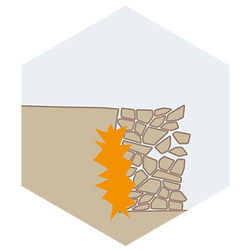
Collapsing/unstable top layer

Explosives not covering the entire hole

Hole connection
Model D in action
Model D can be used with almost any drill rig. With basic training, anyone can install plastic casings. The lightweight polyethylene is easy to lift and carry by hand.
Model D is designed to directly drill the blast hole after installing the casing with its drill-through pilot bit. The entire process of installing casing and drilling can be done with the same rig, in one go. This is how it works:
-
Model D casing system drives down the casing while simultaneously drilling the hole.
-
Once the casing has reached its target depth, disconnect the pilot from the ring bit set connected to the casing, or have the option to continue drilling in one single pass with the pilot bit.
-
When the hole is completed, pull the drill string up and leave the casing in the ground to protect the hole and make the next operation simpler.
-
The casing is only installed in the first section of the hole and the rest is drilled with the pilot bit, or a drill bit that fits through the ring bit set.
-
The hole is protected as the casing is installed, preventing collapse in the covered section.

1. Face Survey

4. Charging with explosives

2. Drilling case of the hole
5. Detonating the explosives

3. Checking the hole

6. Shotpile ready for loading
Customization
Model D is designed to adapt to the different needs of drillers, operating in different locations. This versatility applies to the blast hole diameter and length of casing.
The system is suitable for when the top layer is problematic and helps to keep the hole open to the competent rock.
Ability to drill casing as a single pass, where cased depth is the maximum of rig feed length is one of Model D’s best attributes. There is no limitation on rock hole depth.
Model D can be used with both DTH and Top-Hammer equipment.
The Benefits of Model D
Easier uninterrupted drilling
The plastic casing prevents hole collapse and leads to an easier and more cost-effective drilling program.
Save valuable time
Minimal disruption to drill patterns – the pilot bit used to drill the hole below the casing means no change of drill bit or rig is required.
Free up drill rig availability
Holes protected by the casing during and after drilling result in less movement of drill rigs to clean out drilled holes after they are finished.
Fragmentation
Results show more even levels of fragmentation leading to fewer secondary blasts.
Bench floor
Holes better secured on the bench reduces the issue of bench toes or uneven bench floor levels.

Hole drilled with Model D

Collapsed hole drilled with a standard method